/Outsourcing
Ecommerce Outsourcing: Customer Support, Returns, Catalogs, and Admin Ops
July 8, 2026
/Outsourcing
July 8, 2026
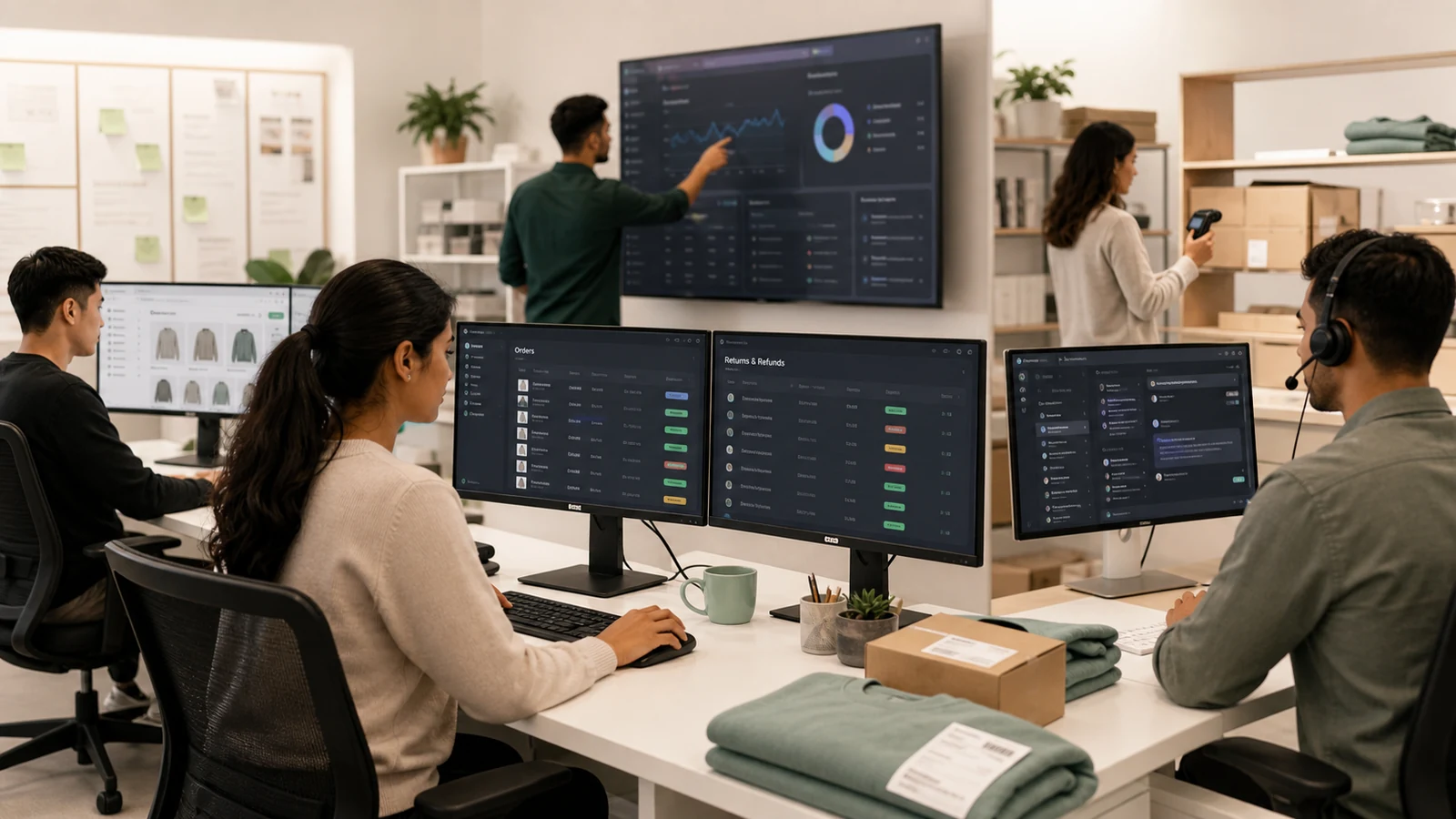
Ecommerce outsourcing becomes attractive when order volume starts creating operational drag. Support tickets pile up. Returns need review. Catalog data gets stale. Marketplace listings drift. Inventory updates are late. Reporting becomes a weekly scramble. The store is growing, but the operating rhythm is starting to fray.
The solution is not to hand the whole store to an outside team. The better move is to separate repeatable operational work from brand, product, and customer-relationship decisions. Outsource the work that can be documented, measured, and reviewed. Keep the judgment-heavy work close until the workflow is mature.
This guide explains what ecommerce teams can delegate, how to control quality, and where outsourcing should be paired with automation, dashboards, and internal ownership.
Ecommerce outsourcing can cover customer support, order updates, returns administration, refund preparation, product catalog work, product data cleanup, marketplace operations, inventory admin, vendor coordination, reporting, and back-office task queues.
The category is broad. Acelerar lists ecommerce outsourcing services such as product listings, catalog management, marketplace optimization, data migration, order processing, inventory management, returns handling, and customer data updates. Vserve describes Shopify management tasks including product data entry, customer support, order fulfillment coordination, catalog updates, and returns processing.
Those are useful examples, but the operating question is more important than the service menu: which workflows are stable enough to hand off, and what controls protect the customer experience?
Outsourcing makes sense when internal operators are spending too much time on repeatable admin work instead of improving the store, products, merchandising, retention, or customer experience. It is especially useful when volume spikes are predictable around promotions, holidays, launches, or marketplace campaigns.
Good signals include:
The goal is not to remove internal ownership. The goal is to give the business a cleaner operating layer.
Start with work that is repetitive, policy-driven, and easy to sample for quality.
These tasks are operationally important, but they do not usually require the founder, head of ecommerce, or CX lead to touch every item.
Customer support is often the first ecommerce workflow to outsource because ticket volume is visible and painful. But support should be handed off by category, not as one big queue.
Start with routine questions: order status, return instructions, shipping updates, product availability, size-guide links, account updates, and simple policy questions. Keep sensitive complaints, VIP customers, social escalation, chargebacks, legal threats, complex product issues, and high-value refund decisions internal.
Influx recommends simplifying the support experience and making ticket triage a priority before scaling outsourced Shopify support. That is the right sequence: clean routing first, then capacity.
Returns are where ecommerce outsourcing can help a lot, but also where loose controls can create margin leakage. An outsourced team can review eligibility, verify order details, provide return instructions, check photos or condition notes, update status, and prepare refund cases.
Final refund approval, fraud policy, unusual exceptions, and customer goodwill decisions should be governed internally. The outsourced team can prepare the case; the business should own the policy.
Shopify's 2026 returns management guide emphasizes rules, policies, and structured returns management. Inventory Source similarly frames returns and refunds around structured RMA workflows, fraud checks, and operational transparency. The takeaway is not that automation or outsourcing eliminates return risk. It is that returns need rules, status visibility, and human review for exceptions.
Catalog work is a strong outsourcing candidate because it is repetitive and detail-heavy. Operators can update descriptions, tags, categories, size charts, product images, variant options, metafields, SEO fields, bundles, and marketplace listing attributes.
The key is source control. The team should know which product information source wins: PIM, Shopify, ERP, supplier spreadsheet, merchandising brief, or marketplace file. Without source-of-truth rules, catalog outsourcing becomes copy-paste drift.
Quality checks should include sample audits, required-field checks, image/variant verification, naming conventions, and marketplace error reports.
Ecommerce teams often lose time answering questions that come from poor order visibility. An outsourced operations assistant can check order status, tracking, warehouse notes, inventory discrepancies, carrier issues, and fulfillment exceptions.
They can also maintain exception queues: orders stuck in pending status, failed fulfillment, missing tracking, oversell risk, backorder updates, and delayed shipments. The internal team should keep ownership of policy decisions and vendor escalation strategy.
Descartes describes centralized order management as a way to process, manage, monitor, and communicate order status across channels. Even when a team does not add a new order management platform, the operating idea is useful: one visible queue beats scattered status chasing.
Marketplace admin can be a hidden source of rework. Listings need accurate attributes, titles, images, stock information, pricing, compliance fields, promotional updates, and issue monitoring. Each marketplace has its own rules, and small errors can suppress listings or create customer confusion.
Outsource the repeatable monitoring and update work. Keep channel strategy, pricing decisions, brand positioning, and policy disputes internal unless the provider has deep marketplace expertise and clear authority.
Reporting prep is a good outsourcing candidate when the internal owner still interprets the numbers. An outsourced team can pull weekly support volume, top contact reasons, return reasons, refund volume, delayed orders, catalog error counts, marketplace issue counts, and backlog by queue.
The internal team should use that reporting to make decisions: improve product pages, change policies, adjust inventory planning, update macros, or fix fulfillment handoffs.
Use this framework before delegating ecommerce operations:
Useful ecommerce outsourcing metrics include:
Track metrics by workflow, not only as one blended operations number. Catalog accuracy and support speed are different kinds of quality.
Keep brand voice ownership, final refund policy, fraud policy, pricing strategy, merchandising decisions, customer goodwill exceptions, supplier negotiations, marketplace dispute strategy, and analytics interpretation internal at first.
Those decisions affect margin, brand trust, or strategic positioning. Outsourced operators can prepare clean cases and maintain the workflow, but internal leaders should own the final rules.
Week 1: choose one workflow, document the SOP, define access, create templates, and set the scorecard.
Week 2: process a limited batch with high review. Sample every refund case, catalog update, or support reply.
Week 3: move to sampled QA, review recurring exceptions, and update macros, product data rules, or return instructions.
Week 4: evaluate backlog, turnaround time, quality, customer impact, and internal management time. Expand only if quality is stable.
Opsline Studio helps ecommerce teams turn scattered operational tasks into structured workflows. That can include support triage, returns queues, catalog QA, marketplace issue monitoring, inventory exception reporting, dashboards, SOPs, and trained operators.
The right first move is usually not outsourcing everything. It is choosing one workflow where better structure will reduce operational drag without weakening customer trust.
Ecommerce outsourcing works when the work is defined, measurable, and governed. Delegate routine support, returns intake, catalog maintenance, order updates, marketplace monitoring, inventory admin, and reporting prep. Keep policy, brand, margin, and strategic decisions internal.
As order volume grows, the advantage comes from building a stronger operating system around the store. Outsourcing is one piece of that system, not a replacement for ownership.