/Outsourcing
Data Entry Outsourcing: How to Improve Accuracy and Turnaround Time
July 8, 2026
/Outsourcing
July 8, 2026
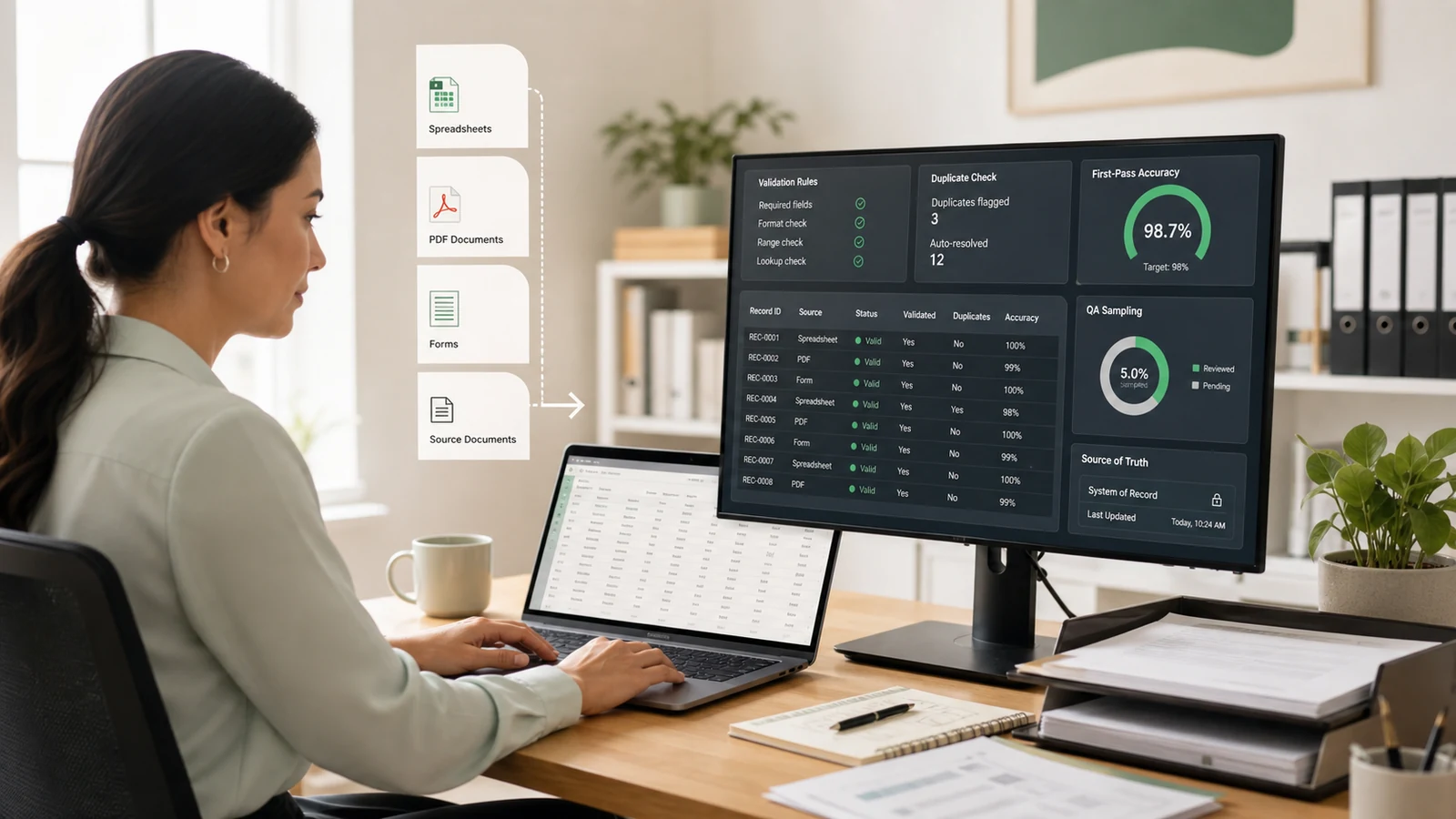
Data entry outsourcing is often framed as a cheap labor decision. That is too small a view. The real value is not typing at a lower hourly rate. The real value is turning messy, repetitive information work into a controlled data workflow with validation rules, quality checks, source-of-truth decisions, turnaround commitments, and reporting.
When data entry is managed poorly, errors spread downstream. A wrong customer address creates fulfillment issues. A duplicate CRM record creates sales confusion. A missing invoice field delays payment. A mistyped claim or order number triggers rework. Bad data does not stay inside the spreadsheet where it was created.
Good data entry outsourcing is about accuracy, speed, and operational trust.
Data entry outsourcing means assigning data capture, cleanup, validation, formatting, or migration work to an external team. The work may involve spreadsheets, CRMs, ERPs, invoices, forms, PDFs, scanned documents, ecommerce catalogs, customer records, claim packets, vendor records, survey responses, or order data.
The category overlaps with data processing outsourcing. Data entry is the act of capturing and entering information. Data processing adds structure: classification, validation, deduplication, enrichment, transformation, and reporting.
That distinction matters. If the business only buys typing, it gets typed data. If it buys a data workflow, it gets cleaner information that can be trusted by downstream teams.
Accuracy is only one part of data quality. IBM summarizes DAMA data quality dimensions such as accuracy, completeness, consistency, timeliness, uniqueness, and validity. Those dimensions are useful because data can be typed correctly and still be bad.
A phone number can be accurate but formatted inconsistently. A customer record can be complete but duplicated. A product SKU can be valid but assigned to the wrong source system. A report can be correct but delivered too late to matter.
Data entry outsourcing should therefore define quality across several dimensions:
Good candidates are repeatable, high-volume, rules-based, and easy to sample for quality. Examples include invoice field capture, CRM cleanup, catalog updates, order entry, survey coding, form transcription, document indexing, claims packet data capture, spreadsheet normalization, vendor record updates, and database migration cleanup.
These workflows can be defined with templates, field rules, examples, validation checks, and QA samples. They also create visible relief for internal teams because the work is repetitive and interruptive.
Do not outsource data work that depends on unresolved business judgment. If nobody can decide which source system is correct, the outsourced team cannot fix that. If field definitions are vague, the team will guess. If exceptions require sensitive customer context, pricing authority, legal interpretation, or strategic decisions, keep those decisions internal.
A simple rule: outsource execution and cleanup after ownership is clear. Do not outsource ambiguity and hope it becomes structure.
Every data entry workflow needs source-of-truth rules. These rules define which system wins when records conflict.
For example, if a customer address differs between the CRM and billing system, which one should the operator use? If a vendor name appears three different ways, which naming convention applies? If an invoice date conflicts with an email date, which field should be entered?
Without source-of-truth rules, data entry becomes opinion work. With rules, operators can move faster and escalate only true exceptions.
Validation rules prevent errors before they spread. Common rules include required fields, allowed formats, dropdown values, character limits, date ranges, duplicate checks, total matching, address format checks, email syntax checks, product SKU matching, and cross-field logic.
Some validation can be automated in spreadsheets, forms, CRMs, databases, or workflow tools. Some requires human review. The best process combines both: software catches obvious rule violations, and operators review ambiguous cases.
Data entry quality should be checked through a defined QA system, not occasional spot checks when something breaks.
Useful methods include:
ARDEM describes double-entry verification as a process where two operators enter data independently and discrepancies are flagged for review. That method is not necessary for every field, but it is useful for high-risk or high-value data.
A data entry outsourcing partner should report both speed and quality. Useful metrics include:
Do not measure speed alone. Fast bad data is expensive. The better target is clean records delivered within the agreed turnaround time.
Turnaround time should be defined by workflow type. A simple catalog update may have a 24-hour SLA. A high-volume migration batch may be measured daily. A claims or invoice queue may need same-day triage and next-day completion for standard records.
Set separate expectations for standard records and exceptions. Otherwise, one messy record can make the whole workflow look late. Track both normal throughput and exception aging.
ARDEM notes that defined SLAs help make data processing performance predictable. Predictability is the point. The internal team should know what will be done, when, and with what quality threshold.
Data entry often touches customer, financial, operational, or healthcare information. The outsourced team should receive only the access needed for the task. Use role-based permissions, secure file transfer, audit trails, password management, and clear rules for downloading or storing files.
For sensitive workflows, define whether data should be masked, restricted by field, reviewed in a controlled portal, or split so operators do not see more information than necessary.
Ask potential data entry providers these questions:
Opsline Studio is useful when data entry is really a workflow problem. That may include source-of-truth rules, intake forms, validation checks, dashboards, QA sampling, operator training, and exception routing.
The goal is not to throw people at a spreadsheet. The goal is to create a cleaner system for capturing, checking, and moving information through the business.
Data entry outsourcing works when accuracy and turnaround are designed into the process. Define the source of truth. Build validation rules. Use QA methods that fit the risk. Track the right metrics. Keep exceptions visible. Improve the SOP every week.
Cheap typing creates hidden rework. Controlled data workflows create usable information faster.